- Share
-

-

-

-

The tallgrass prairies and oak forests of The Morton Arboretum are gracious hosts to more than a million visitors each year. In 1922, toward the end of his life, Joy Morton converted some of the fortune he had amassed in the salt business into a botanical library and herbarium about 25 miles west of Chicago.
Several generations have passed since then, and many Illinois families have memories perfumed with the buttered-popcorn scent of prairie dropseed, or tinged with the red and gold of oaks blazing through the waning days of Autumn. Far fewer know what goes on inside the greenhouses and laboratories of the arboretum. There scientists study trees down to the microscopic level, and use that knowledge to ensure the future of the region’s forests, be they in wilderness preserves to urban neighborhoods.

Wind buffets fall foliage near Schulenberg Prairie. The arboretum has spent 60 years restoring 100 acres of tallgrass prairie, savanna, and wetland habitats. Photo by Jasmin Shah.
The Tree Cookies of Time
Many scientists collect strange things. Christine Rollinson has storage racks stacked with cross-sections of trees. Just an inch or two thick and delightfully referred to as cookies, these slabs of dried wood are records of climate conditions dating back more than a century.
“This is my time machine,” says Rollinson, a senior scientist in forest ecology at the arboretum.
Many people know you can count a tree’s rings to determine its age, but Rollinson’s analysis goes deeper. The thickness of those rings tell a story about the tree’s environment in the year it appeared. Trees tend to grow slower during drought, floods, and outbreaks of pests or disease.
“These rings can sometimes be thinner than human hair,” Rollinson says. “Literally one cell.” It’s common in older trees to see cycles of “release” and “suppression,” she says, which likely indicate a passing weather event.
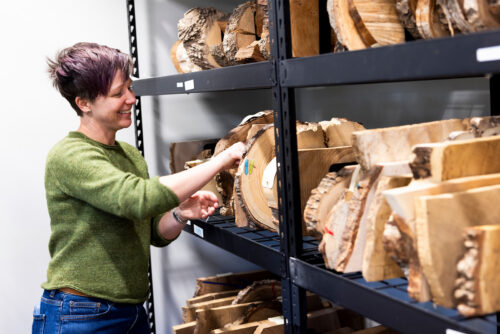
“This is my time machine,” says Christine Rollinson, a senior scientist in forest ecology at the arboretum. Photo by Jasmin Shah.
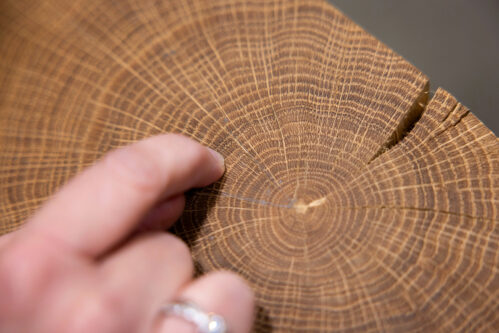
The thickness of each tree ring tells a story about the tree’s environment in the year it appeared. Photo by Jasmin Shah.
Other threats are long-term, like the pestilence of the emerald ash borer, an invasive beetle that has killed hundreds of millions of trees since the 1990s.
Rollinson pulls out a cookie labeled UNK-009, a white oak removed in July 2021. She points to a pale band of wafer-thin rings that span about a decade of the tree’s life.
“Something was making this tree sad for a very long time,” she says. Since multi-year droughts are unusual in the Midwest, the likely culprit is a pest. UNK-009 survived. After it prevailed, the tree went through a growth spurt. Its acorns may now be young trees in the arboretum.
To learn even more from this archive, which goes back to the early 1800s, dendrologists use advanced tools to count microscopic vessels of xylem, the tree’s inner aqueducts moving water and nutrients up from its roots. Scientists scrutinize digital scans of tree cookies using artificial intelligence. They get a snapshot of the tree’s health by counting the ratio of isotopes absorbed in each ring. Some even use micro-computed tomography (CT) imaging to travel into the tree’s past.
“They literally put wood in an MRI machine,” Rollinson says.
Fortunately for the arboretum’s living trees, there are ways to see into them without extracting cores of their trunks. Rollinson wants to use hyper-spectral imaging to analyze leaves in real-time. Even without that technology, plant scientists studying an archive of leaf pressings have determined Spring blooms in the arboretum start on average two to three weeks earlier than they did a century ago–climate change is playing off winter and rushing in Spring.
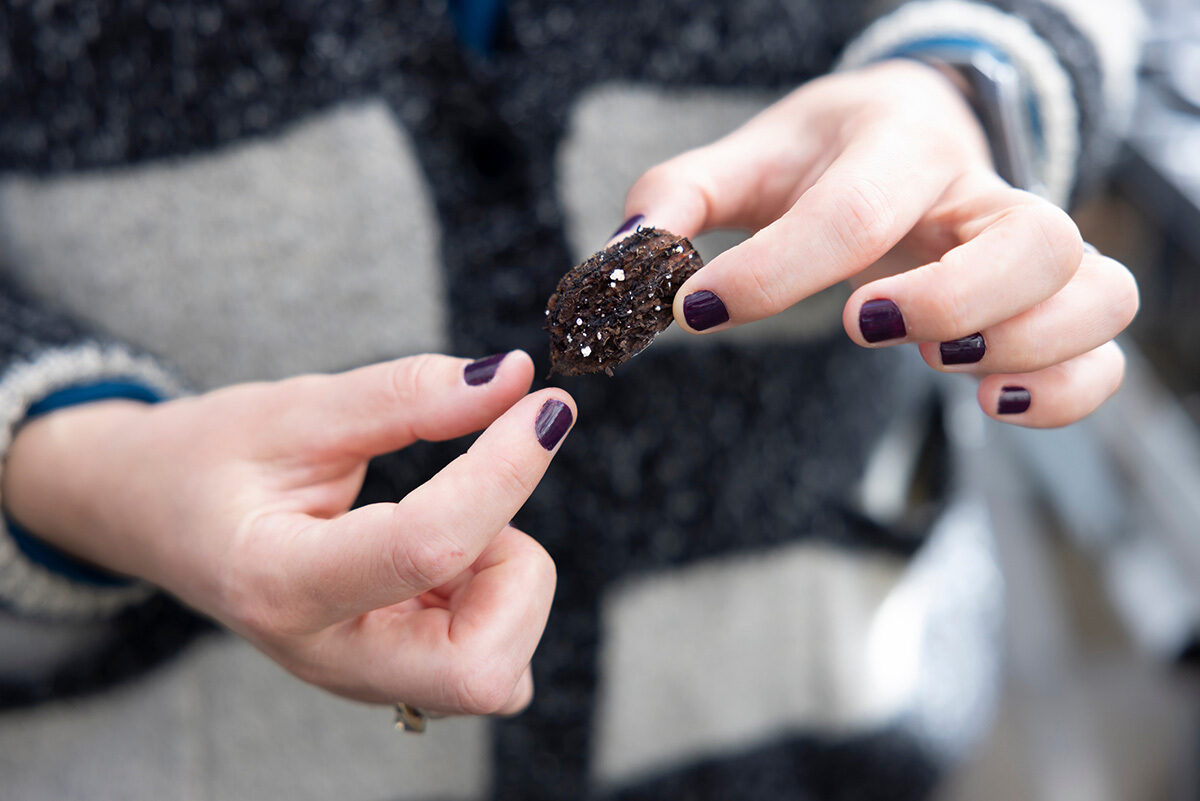
Emma Leavens, Tree Conservation Biology program manager, with a butternut seed in the arboretum's greenhouse. Photo by Jasmin Shah.
Saving the ‘countryman’s tree’
Scientists at the arboretum are not just documenting how climate change and other environmental conditions affect trees. They’re helping rehabilitate species, too.
That includes the butternut. Also known as white walnut, the butternut (no relation to the squash) lacks the cachet of its cousin the black walnut. But it has been part of American diets for decades. In 1949’s “A Natural History of Trees,” Donald Culross Peattie writes: “A countryman’s tree is the Butternut, known to the farm boy but not his city cousin.”
One reason for their relative obscurity in recent years is the advance of a lethal fungus known as butternut canker. Its intimidating scientific name Ophiognomonia clavigignenti-juglandacearum is shortened to OCJ, and it’s a major reason the International Union for Conservation of Nature has listed the butternut as endangered.
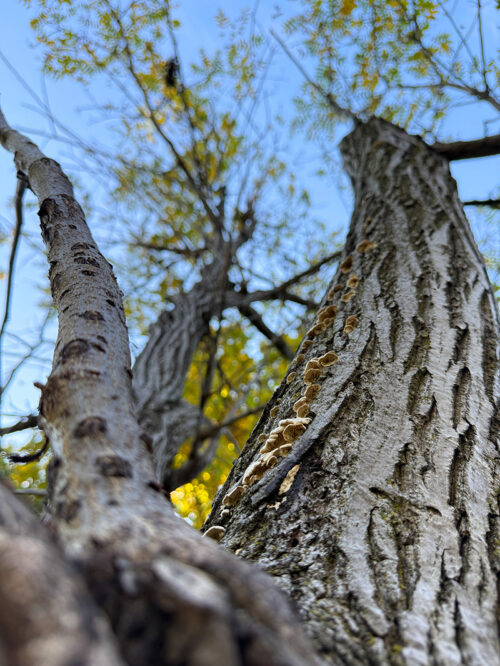
The butternut has been part of American diets for decades. Photo by Alison McKinzie.
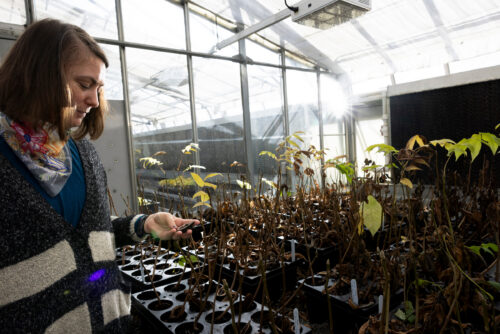
“This is very exciting to have this many butternut seedlings,” says Emma Leavens, surveying the nursery. “It’s really useful for getting a comprehensive picture in time and space.” Photo by Jasmin Shah.
Emma Leavens, the arboretum’s program manager for tree conservation biology, checks on a greenhouse full of young butternuts. These seedlings were contributed by farmers, forest managers and botanists from Vermont to Wisconsin. Leaven is looking through the collection for clues about how to fight back against OCJ. Why, for instance, do some plants survive the affliction when so many succumb?
“This is very exciting to have this many butternut seedlings,” she says, surveying the nursery. “It’s really useful for getting a comprehensive picture in time and space.”
Some of the plants are natural hybrids, and one research question is how it affects survival rates when a butternut is crossed with Japanese walnut. Another is how soil conditions impact a butternut’s chance of fending off canker.
“What we have left are the ones that have been living with the pathogen for decades,” she says. “Some of helping a species is being able to say, ‘yes there’s good reason to hope for this and here is something we can do.

Wind buffets fall foliage near Schulenberg Prairie. Photo by Jasmin Shah.
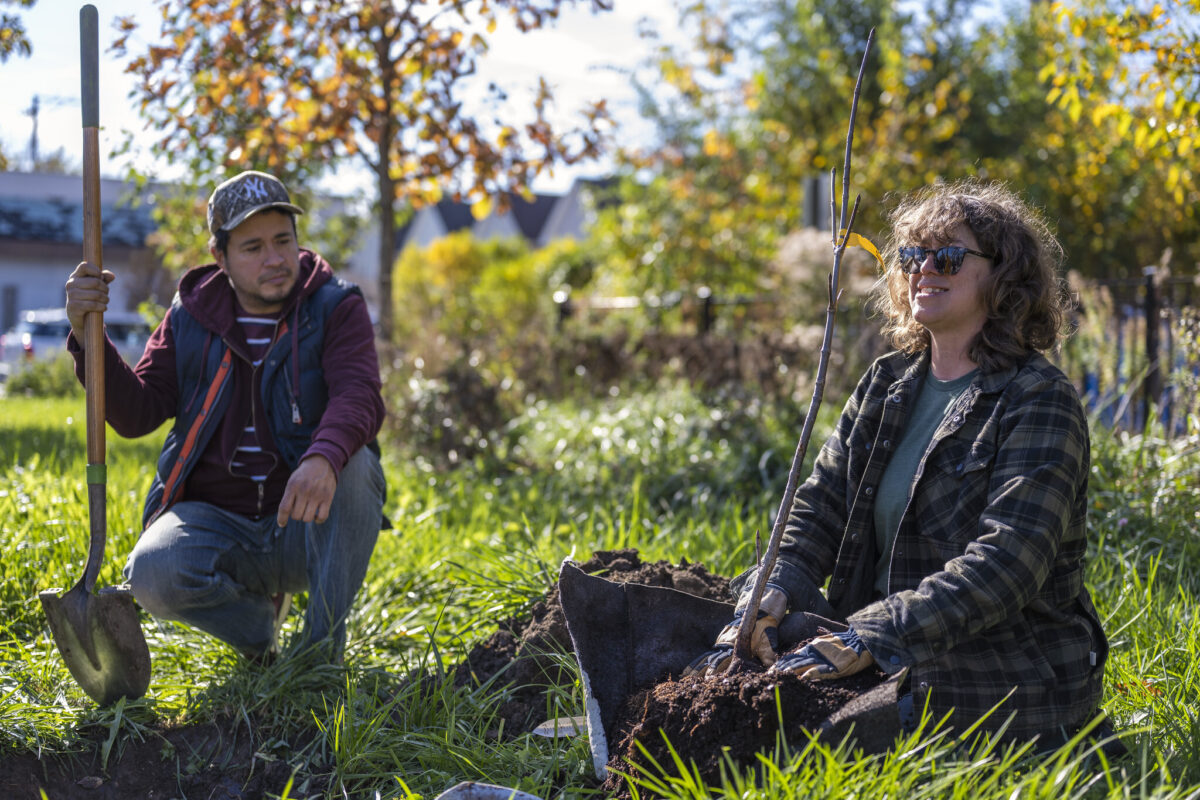
Kate Perryman, right, and Carlos planting a buckeye at a park in North Lawndale with the Chicago Region Trees Initiative. Photo by Chris Bentley.
Urbs in Horto
Chicago’s Latin motto translates to “City in a Garden,” and the Morton Arboretum is doing its part to make sure that title is earned. The Chicago Region Trees Initiative, a collaborative effort led by the arboretum and Openlands, has dispersed thousands of saplings since 2014.
A few dozen more made their way into the North Lawndale neighborhood on a sunny Saturday in November. During the neighborhood's inaugural Harvest Fest, people made their way from giveaways of food and books to a tree-planting demonstration led by Kate Perryman.
After planting a buckeye in front of a small crowd, Perryman helped distribute young plants including buttonbush, Illinois pecan, ninebark and red bud. Those aren’t just any species–the arborists at the Chicago Region Trees Initiative follow a mantra: “Right tree, right place.”
“How big does the species get? What does it need? Is it the right fit?” says Perryman, an art professor turned stewardship specialist.
Erica Seltzer found a spice bush to be the right tree for her place, the North Lawndale greystone down the street once owned by her grandmother. In the Summer, she says, the air inside can be stifling. Planting trees in the double lot next door has helped cool it down, she says.
“We would go over there and it would be roasting, like a pizza oven,” Seltzer says. She’s been adding to the garden started by her grandparents and so far has planted nine trees and shrubs. In addition to breathing easier, Seltzer says she’s seen the electricity bill fall since she doesn’t need to run the air conditioner as often.
“The more I filled it in, the more I noticed it,” says Seltzer, loading a few plants into a dolly to tote down the alley.
For people less experienced in tending to trees than Seltzer, the arboretum has resources from a year-round hotline (The Plant Clinic; “You can call about a tomato plant. It doesn't even have to be a tree,” says Perryman) to hands-on help from people like Hilary Noble, who carries the respectable title of tree ambassador.
“Trees not only help with mental well-being, but also physical well-being, especially in communities where there are high asthma rates,” says Noble. “They've been shown to help reduce flooding, which in certain communities within Chicago is a real problem.”
Sometimes trees get a bad reputation in the city. One might be blamed for a burst water pipe, for example, and “that’s where resentment can build,” says Perryman. Instead of the roots throttling the pipe, however, it’s more likely the pipe was already leaking underground, and the tree’s roots sought that moisture.
Reshorna Fitzpatrick says she hears that concern from some of her neighbors in North Lawndale. A tree ambassador and a pastor at Stone Temple Baptist Church, Fitzpatrick debunks misconceptions about trees and spreads the good news.
“I tell them, ‘hey look, you get more shade in your house. Your electricity bill is going to be down,’” she says. “And then your mental [state] is going to be so much better. These trees have benefits that we have no idea about.”
This year, with a grant from the nonprofit Faith in Place, Fitzpatrick planted a couple dozen fruit trees at 16th and Lawndale. In a few years the orchard will bear peaches, plums and cherries for her neighbors. She says it’s an investment in the neighborhood.
“When you have a tree canopy it raises the status of your community,” says Fitzpatrick. “We need trees to survive.”
The Morton Arboretum sometimes sums up its mission to plant, study, and conserve trees with a valiant motto: “The Champion of Trees.” In reality its champions are many. They are scattered from the corner lots of North Lawndale to the laboratories in Lisle, and they are all fighting for new growth to prevail.
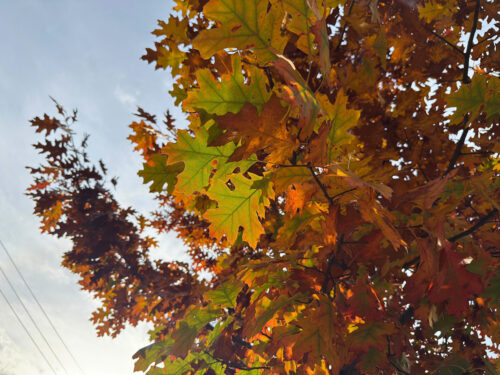
“I tell them, ‘hey look, you get more shade in your house. Your electricity bill is going to be down. And then your mental [state] is going to be so much better. These trees have benefits that we have no idea about.” Reshorna Fitzpatrick, a tree ambassador and a pastor at Stone Temple Baptist Church, advocates for trees by sharing information with her neighbors. Photo by Alison McKinzie.
CRTI hones in on the urban tree canopy directing resources where they're needed most.
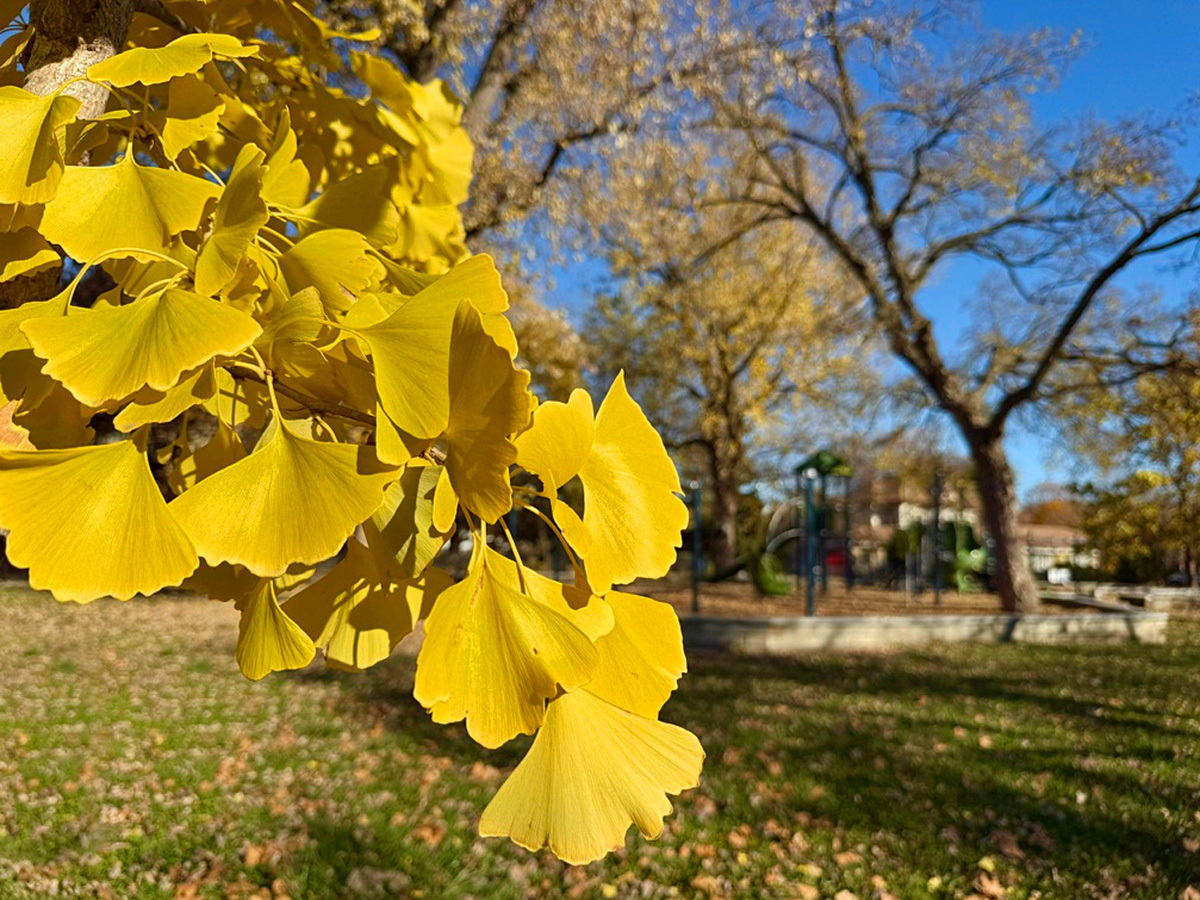
The work of the Chicago Region Tree Initiative branches out far beyond plant giveaways. Scientists at the Morton Arboretum study the urban tree canopy with remote sensors and imaging, zooming out from the microscopic scale of labwork until they have a working image of the region.
“We are working on trying to refine these models at finer spatial scales so that we can understand not just inequity in tree canopy, but inequity in tree quality,” says Christine Rollinson, “and help direct better care to under-resourced neighborhoods.”
